
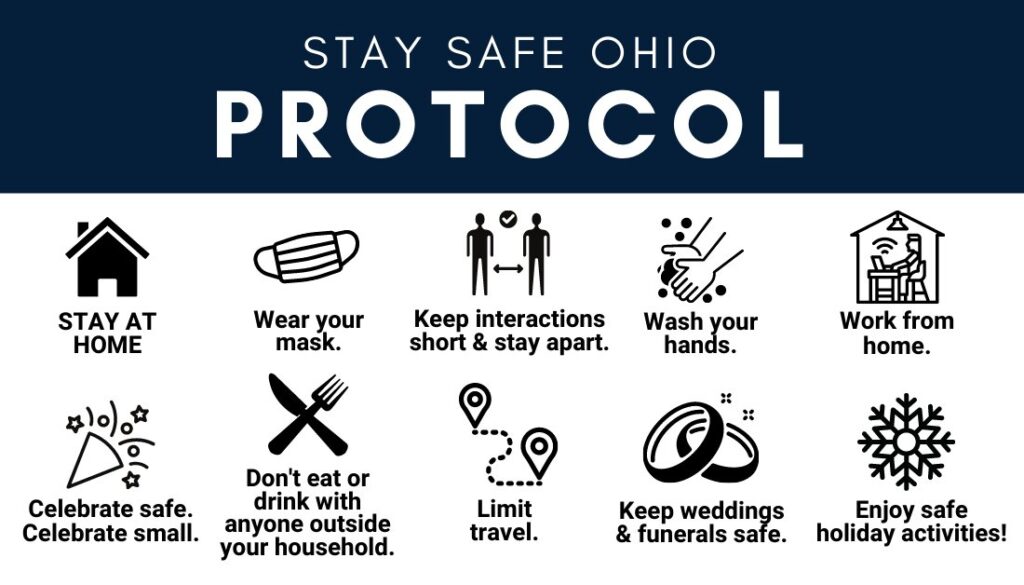
COLUMBUS – From the incoming president to governor of Ohio, health officials and government leaders are pleading with Americans no to travel during the Christmas-New Year’s holiday period to stave off a feared spike in COVID-19 cases in January.
“Wear masks, socially distance and, if you don’t have to travel, don’t travel,” President-elect Joe Biden said Monday after receiving a coronavirus vaccine shot on television.
Ohio is not experiencing a drastic surge in cases related to Thanksgiving gatherings which Gov. Mike DeWine attributes to the fact that Ohioans greatly reduced their contacts and travel over the holiday.

“Not enough to make things better, but enough to not make things worse, and I think that’s probably a pretty good description of exactly what happened, and we got to hang in there over Christmas and New Year’s,” he said during a Monday briefing, citing data published in the New York Times that there was a 60 to 70% reduction in contacts over the Thanksgiving holiday.
A map published by the newspaper (see illustration) indicated that most of Ohio’s 88 counties recorded fewer contacts than in 2019, some reducing the number by half or more.
“Up to and through Thanksgiving, Ohioans took important steps to avoid letting COVID-19 overwhelm our hospitals, but in spite of this, our hospitals remain extremely busy,” said Dr. Bruce Vanderhoff, Ohio Department of Health chief medical officer.
“Adding a post-holiday spike would create a terrible situation, so we can’t let ourselves be lulled into a sense of complacency as we move into the next two-week period, the biggest holiday season on our calendar,” Vanderhoff said.
The Ohio Department of Transportation reported that traffic volume across the state was down an average of 20% during the Thanksgiving holiday weekend and the auto club AAA predicts 1.4 million fewer Ohioans will travel between Wednesday and Jan. 3, a decline of at least 30% from last year.
Nearly 70,000 people were expected to depart from John Glenn Columbus International Airport during the two-week travel period than began Dec. 18 and concludes on the 31st, compared to 176,000 in 2019.
Airport officials say passenger traffic would be about 40% of 2019 levels.
The state reported 6,548 new cases of COVID-19 Monday, much lower than the 21-day rolling average of 9,919 new daily cases. There have been a total of 629,354 cases since the pandemic began in March.
The number of deaths grew to 8,122 with 35,048 hospitalizations, an increase of 301 new hospitalizations in the last 24 hours. The 4,807 current COVID-19 patients were occupying 17.4% of the state’s inpatient beds.
The state reported a 13.9% rate of positive coronavirus tests over the past seven days, the lowest since Nov. 21.
The state says 6,733 Ohioans have received valid vaccine doses so far.