
COLUMBUS — Six-foot gaps between workers. Masks, gloves, barriers, hand sanitizer. These are things Ohioans can expect to find commonplace when life in the state enters the next phase of the battle against COVID-19.
The Ohio Department of Health call center is open 7 days a week from 9:00 a.m. to 8:00 p.m. to answer questions regarding COVID-19 at 1-833-4-ASK-ODH (1-833-427-5634).
Click here for the latest information:
Ohio Department of Health coronavirus website
Ohio COVID-19 Dashboard displays the most recent preliminary data
Centers for Disease Control and Prevention
During his daily televised Statehouse briefing Friday, Gov. Mike DeWine clarified some of the guidelines under which non-essential workplaces and businesses will be allowed to reopen sometime after May 1.
Meanwhile, hundreds of protesters gathered at the Ohio Statehouse for about two hours Saturday to demand that the governor end restrictions on public gatherings, workplaces, mobility and schools and the operations of stores and restaurants, Cleveland.com reported.
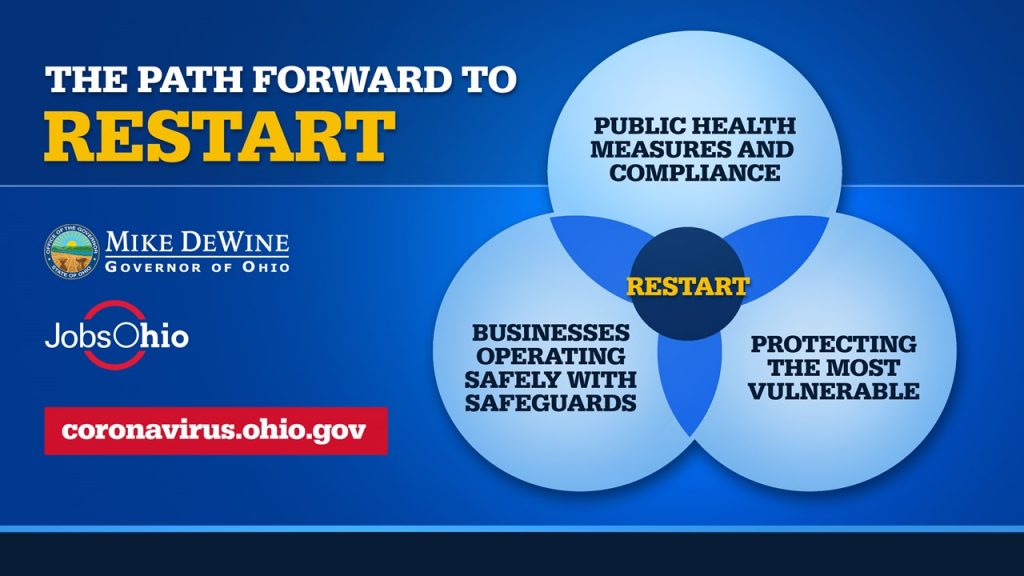
The easing of those restrictions will depend on achieving a balance between compliance with public health measures, safe business operations and protections for those at highest risk from coronavirus infection, DeWine said (see illustration above).
Ohio must be careful to avoid a situation where new cases spike after society starts to reopen, he said.
He said employers would be expected to create safe distances between workers and customers, as well as each other, encourage the wearing of masks and gloves, and clean frequently touched surfaces often.
Arrival times and lunch breaks could be staggered so that workers do not gather in confined areas, DeWine said. Employers could screen employees by taking temperatures and sending potentially sick workers home, and encourage employees to work from home as much as possible.
Stores and restaurants might be required to limit customers and diners and businesses must provide ample opportunities for workers and customers to wash and sanitize their hands.
Lt. Gov. Jon Husted is heading up the effort to hash out details of the reopening plan.
DeWine did not say whether schools would be allowed to reopen on May 1, promising more information about that early next week.
The state health department reported Sunday there were 11,602 confirmed and probable cases of COVID-19 in Ohio and 471 deaths
-0-
The state prisons agency says National Guard members are being trained to help at a second Ohio prison as coronavirus cases among correctional workers increase.
The guard members will assist with “mission critical functions” at Marion Correctional Institution, JoEllen Smith, spokeswoman for the Department of Rehabilitation and Correction, said Friday.
That’s where more than a quarter of employees have now tested positive for the coronavirus. Testing of one prison dorm in Marion found that out of 152 inmates, 39 percent tested positive for COVID-19 although they did not show any symptoms, DeWine announced.
Smith says the State Highway Patrol is providing security at the prison’s perimeter. The union representing prison guards says extra workers are needed to boost staffing in state correctional facilities.
Marion is one of three state prisons where comprehensive testing of inmates is underway. Testing has also begun at Pickaway Correctional Institution and Franklin Medical Center. Ohio is believed to be the first and only state in the country to conduct comprehensive testing in state prison settings.
With the start of wider testing, the state expects higher reports of COVID-19, DeWine.
-0-
Among the Ohio inmates to be released early because of the coronavirus outbreak is a former Republican fundraiser convicted in a state investment scandal.
A list of commutations DeWine announced Friday includes former Toledo-area coin dealer Tom Noe. He was the central figure in the scandal that engulfed Ohio’s Republicans in 2005.
The investigation led to 19 convictions that reached up to then-Ohio Gov. Bob Taft. DeWine says Noe served a significant portion of his sentence already, has a clean prison record, will be closely supervised, and is better situated to pay restitution if he’s not in prison.